the intruder’s flashlight
A Murder Is AnnouncedThe intruder’s flashlight is both the practical tool that stages the apparent hold-up at Little Paddocks and the means by which the scene conceals what really happened. Its powerful, moving beam dazzles the guests and monopolizes their attention; the certainty that they saw a masked gunman is therefore not reliable proof of what they could see at the time. When Jane Marple and Inspector Craddock reconstruct the scene, the flashlight’s glare and the witnesses’ differing positions help explain how a false impression became a shared memory—and how one person could have seen what the others could not.
Appearance and Use in the Hold-Up
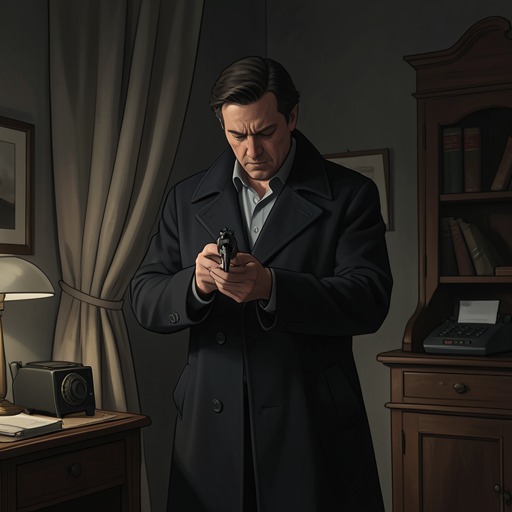
The flashlight enters with the figure at the drawing-room doorway after the door crashes open. Its beam sweeps rapidly around the room, accompanying a hoarse command to put hands up. In the dark, the light’s force gives the scene its immediate shape: people react to being addressed and dazzled, not to a calm opportunity to study the intruder. One witness later describes the torch as horribly dazzling and says that it made the guests blink; Craddock accordingly asks whether the intruder held it steady or moved it about. The distinction matters because a moving beam directs attention from face to face and object to object rather than offering a sustained view of the person holding it.
The apparent performance turns into real violence before the guests can recover their bearings. Two revolver shots break the room’s complacency; a third follows as the doorway figure turns, hesitates, and collapses. The flashlight falls and goes out, leaving the room dark again. The guests are thus left with the remembered sequence of a commanding voice, a powerful beam, shots, and a falling figure, but without a continuous, well-lit view of the person who entered.
The Limits of Eyewitness Vision
The subsequent accounts initially seem to establish a straightforward fact: the witnesses say they saw a masked man with a revolver and a torch open the door and hold them up. Craddock challenges that apparent consensus by asking whether they could actually have seen anything at all. With no light in the hall or on the landing, a powerful flashlight aimed from the doorway would make the beam itself the most visible thing in the room. Craddock has tested the effect: someone facing that beam could see little beyond its glare. The witnesses’ agreement that there was a masked intruder therefore cannot simply be treated as independent visual confirmation of his appearance.
The flashlight helps explain how reports can feel certain while resting on incomplete perception. The guests were startled, looking into a bright beam, and responding to a simulated robbery; what they later said they had seen could incorporate the intruder’s appearance as it became available after the lights came on. Jane Marple recognizes the crucial distinction between seeing a torch-lit figure and truly seeing the person in the doorway. Craddock’s deliberately confident account of the witnesses’ supposed certainty tests whether she will accept their repeated description as an established visual fact. She does not: the flashlight makes that description suspect rather than conclusive.
Position, Glare, and the Exceptional Witness
The beam’s effects depended on where each person stood. One guest was behind the door, with the door between her and the flashlight. Unlike the others, who were dazzled as they faced it, she was not blinded by the light in the same way; she was oriented toward the direction in which the beam pointed. Jane Marple draws attention to this difference when she challenges the witness’s claim that she could see nothing. The flashlight was not a uniform screen: its ability to obscure depended on the observer’s angle and the door’s position.
That distinction gives the object a double evidential role. For most of the company, the beam obstructed a direct view; for the person behind the door, its path could illuminate what lay ahead. The same moving light that made the room’s collective account unreliable could leave one witness with a potentially different visual opportunity. Jane Marple’s questioning therefore treats the flashlight not as background equipment but as a changing condition of sight, one that must be reconstructed alongside the position of each person in the room.
Recollection and the Reconstructed Scene
Jane Marple’s later explanation of Miss Murgatroyd’s memory shows how the flashlight’s route could survive when the identity and actions of the figure did not. Miss Murgatroyd, prompted to remember what she had actually seen rather than settle immediately on an explanation, mentally follows the beam across the room: from near the mantelpiece along the two windows, past people and furniture, and onward to the wall. Jane Marple compares this kind of sharp incidental recollection to remembering a large blister of paint in a railway carriage or a woman’s mismatched stockings and a hole in one stocking during the shock of a flying bomb. Under strain, a conspicuous detail can remain in the mind even when its significance is not understood at once.
In Miss Murgatroyd’s recollection, the beam’s passage makes a particular absence intelligible. She remembers the wall where two bullet holes were later visible and where Letitia Blacklock had supposedly been standing when she was shot. At the moment of the shooting, however, Letitia was not there. The initially puzzling memory is not that the flashlight revealed a person, but that its movement left a place unoccupied where the later account required someone to have been. The light’s route supplies the spatial sequence by which that absence can be recalled and interpreted.
The flashlight therefore links the staged robbery to the later examination of testimony. During the attack it intensifies fear, narrows attention, and helps create the impression of a masked gunman; afterward, its movement and the witnesses’ different positions provide a way to test what they could have perceived. Its importance lies in this contrast: the beam seems to show the room while, for most of those facing it, concealing the very details on which their account depends.